
Subscription-based pricing is dead?
Someone should tell Clubhouse
We don’t like clickbait headlines, we borrowed this one from TechCrunch, it got us to click, and there is a serious point here. This week we take a look at the top news sites globally and where they get their traffic from. We consider HBO Max’s proposed ad-supported pricing tier. We know that for digital success, good ideas are often outside of subscription businesses that’s why we think Pinterest’s approach to running experiments is a game changer.
We’re sending this out before the New York Times release their Q4 earnings. The expectation is that subscription revenues will be up 35%. We’ll dive into the detail next time.
From Grow & Retain
11 books to boost subscriptions

Unlike people who are boosting physical book sales to ensure they have a great backdrop for their Zoom calls, we suggest actually reading the 11 books we’ve picked. The business of subscriptions covers a range of disciplines, and our book choice reflects that. From influencing user behaviour, to analytics, to customer experience. We have found something in each of these books that will make a difference in a subscriptions business. A favourite is “Blue Ocean Strategy”. The chapters on value innovation will change the way you think about what your product could be. Read more.
In case you missed it…
The death of subscription pricing
There is a movement in SaaS companies to adopt usage-based pricing. Instead of a fixed monthly subscription, companies can add users, or use additional services at will. For the customer, the key benefits of usage-based pricing are flexibility and paying for only what you need. For SaaS companies, usage-based pricing is supposed to lower the barrier to initial take-up and encourage more use. Contrary to the headline, we think there is a place for both pricing models. Usage-based pricing works well for the right sort of SaaS products, those that are inherently about use, for example Mailchimp. But usage pricing can be complicated and encourages rationing. We expect both models to live and thrive and there may be instances when a hybrid works best - base subscription price and then usage pricing where it makes sense. Read more.
How to experiment
Subscriptions-based marketing is about experimenting, reviewing the results, refining activity and testing again. In most companies the approach to what to test is not structured. Often it is in reaction to an issue, “we’re losing subscribers!!!”, or it suffers from the HIPPO effect (highest paid person’s opinion). Pinterest have defined a structured approach to experimentation with their Experiment Idea Review process. Having a formal process to identify what user problem neeeds to be solved, what the current experience is like, and the anticipated result, ensures a more productive approach. It also removes bias. Pinterest also address the human problems with the process and how to tackle them. Read more.
Ad-supported subscriptions
AT&T CEO John Sankey announced last week that HBO Max will add a cheaper, ad-supported subscription tier this year. HBO Max added 17.2 million subscribers in Q4, boosted by Wonder Woman 1984. The service has to find a way to replace subscribers being lost from its traditional Pay TV business. An ad-supported pricing tier could be the way to acquire customers. The key to success will be how many ads and what price is the subscription. The user experience of Netflix is a key element of their success. Having no ads definitely helps this. But creatively and selectively showing ads doesn’t have to damage the user experience. This issue is broader than video, most publishers are either free and ads, or subscribe and ad free. The user experience on the web is being killed by ads, so having none makes sense. But maybe both can exist, someone just needs to reimagine the experience. If they can they will unlock a powerful new model. Read more.
The world’s largest news sites
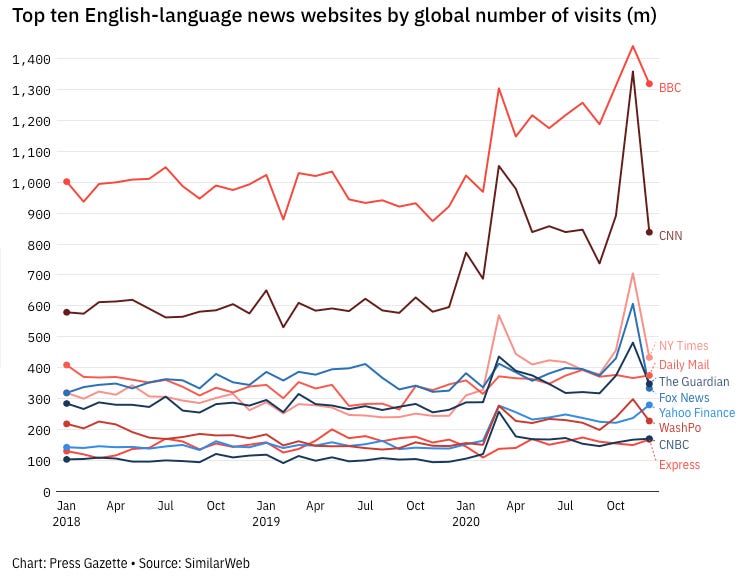
If you can ignore the focus on whether extreme news sites are becoming more popular, then the Press Gazette coverage of news site traffic is well worth a read (it is very English language focused). A key point worth noting is the sheer volume of visits to news sites, and that includes those with a paywall. The New York Times attracted 432 million visits in December. Either their 6 million subscribers are visiting an awful lot, or they have an incredible potential.
We found the table on sources of traffic the most interesting (we love data). In fact we think it shows a fundamental issue for news sites - they are undermarketed. Many have incredible brand strength, for example CNN receiving 64% of all their traffic direct. Or they are far too reliant on organic search, The Express in the UK generates 70% of its readers that way. More noticeable is how poor they are at email. Only one site gets above 2% of traffic this way. And why is nobody using paid search better? Read more.
A Clubhouse subscription?
In case you haven’t heard of Clubhouse, its a new social platform. It’s been generating a lot of hype, not least because you have to get an invite to join. The first users were all the Silicon Valley elite. We admit to feeling a little left out as we haven’t been invited yet! It is unique in that it is all audio-based. You join a room and join the conversation. The app surged last week when Elon Musk joined to discuss a range of topics. Clubhouse CEO Paul Davison revealed last week that one of the likely paths to monetisation is from subscription. People would be able to support creators by subscribing to them. It could be a very smart move as it solves a big issue for social platforms - how do you retain the people creating all the content? Building a subscription model early on would create a compelling network effect. The more effort the creator puts in the more they earn and the less likely they are to leave for the shiny new thing. Read more.
If you’ve enjoyed reading then please share with your colleagues or connections.